Title: Barking Up the Right Tree: AI Unleashes the Secrets of Canine Communication
 In a groundbreaking revelation that could redefine our understanding of our four-legged companions, artificial intelligence has cracked the code of dog barks, unveiling a stunning level of emotional intelligence and communication previously thought unimaginable. Imagine a world where your dog’s barks are translated into human language, revealing their thoughts, fears, and desires. This is no longer the stuff of science fiction; it’s a burgeoning reality.
The astonishing journey began with Dr. Khan Slobedchoff, a dedicated researcher at Northern Arizona University, who spent over three decades studying prairie dogs. His work unveiled a complex language among these seemingly simple creatures, revealing that they could communicate specific threats with remarkable detail. Inspired by this discovery, Dr. Slobedchoff and his team developed an AI algorithm capable of analyzing the acoustic properties of animal sounds, paving the way for similar breakthroughs in dog communication.
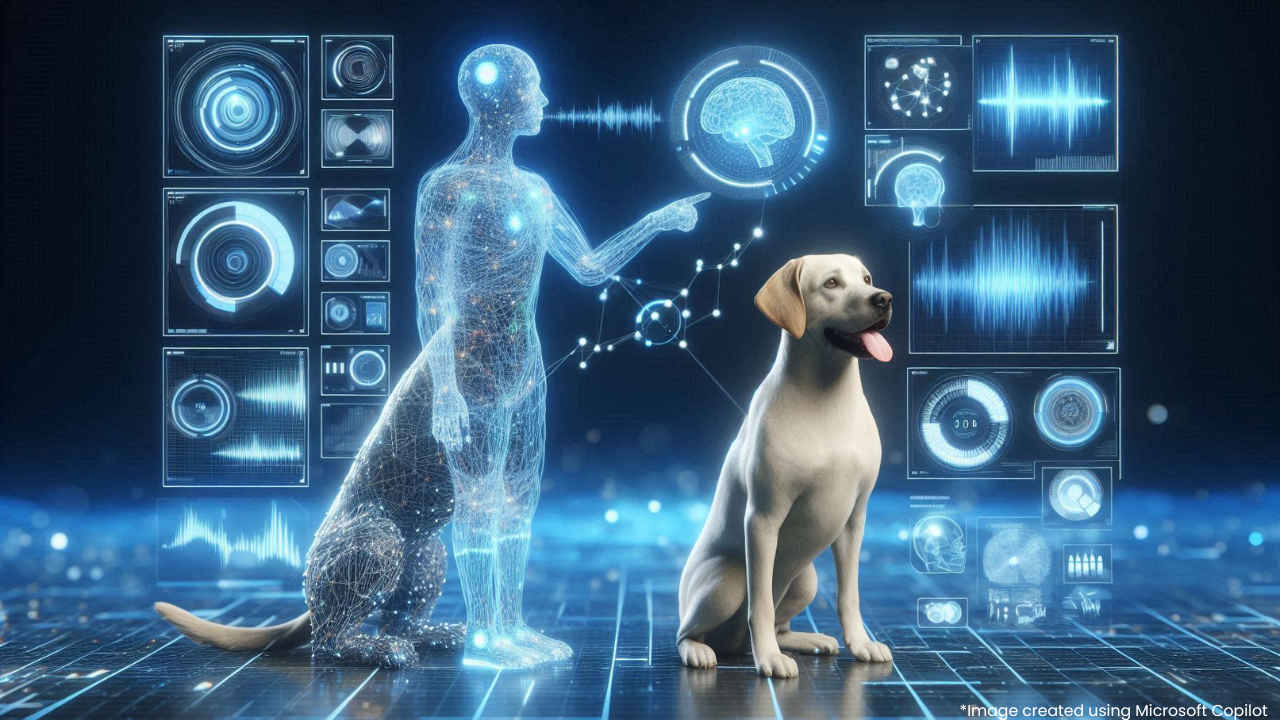
Now, that technology is being repurposed to decode the vocalizations of our beloved pets. Researchers are meticulously cataloging thousands of hours of dog barks, growls, and yips, pairing them with corresponding behaviors and contexts. The results have been staggering; the AI boasts over 94% accuracy in distinguishing between playful growls and aggressive warnings. This marks the dawn of a new era where understanding our dogs could be as simple as pointing our smartphones at them.
But the revelations don’t stop there. Neuroscientist Dr. Gregory Burns at Emory University has taken the inquiry a step further by examining what dogs actually think about us. Using functional MRI technology, Burns discovered that dogs experience the same neurological excitement from praise as they do from food. For some dogs, affection even trumps treats, proving that they see us as more than mere providers of sustenance—they view us as family.

This research has also unveiled the oxytocin loop, a chemical bond that strengthens the connection between humans and dogs. Eye contact between a dog and its owner can lead to a significant spike in oxytocin levels for both parties, creating a profound emotional bond. This biological connection suggests that dogs have evolved to manipulate our emotions, fostering a relationship built on mutual affection.
As we delve deeper into the mysteries of canine communication, we are faced with the intriguing possibility that dogs may perceive things beyond our comprehension. Their uncanny ability to sense changes in the environment, from seismic activity to perhaps even the supernatural, raises questions about their experiences of the world around us.
The implications of this research are profound, particularly for the millions of dogs in shelters deemed unadoptable due to behavioral issues. This new understanding could lead to a revolution in how we interpret canine communication, potentially saving countless lives by offering insights into their emotional states and needs.
While we may not have a device that will allow our dogs to speak in full sentences just yet, the advancements in AI and neuroscience are bridging the gap between species, allowing us to finally listen to what our dogs have been trying to tell us all along. As we embark on this journey of understanding, one question lingers: If your dog could truly communicate, would you be ready to hear what it has to say?