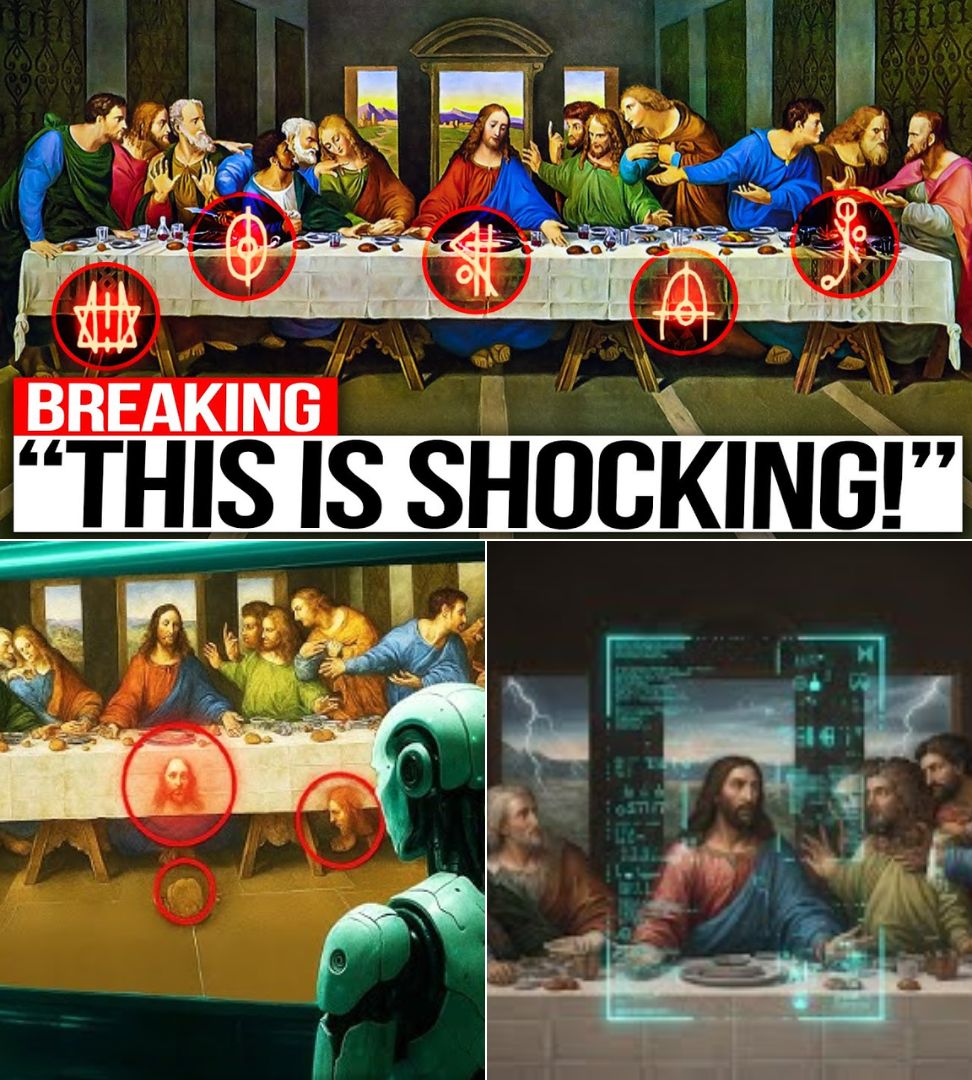
AI technology has unveiled a shocking revelation hidden within Leonardo da Vinci’s iconic masterpiece, The Last Supper, sending ripples of astonishment through the art world. A recent AI scan, conducted under the secretive Project Oculus, has reportedly uncovered cryptic messages embedded within the painting’s layers, leading to dramatic reactions from historians. As the AI translated these hidden texts, it revealed unsettling insights about our future, igniting fears that Da Vinci might have foreseen events such as the internet and global pandemics, prompting historians to collapse in disbelief.
 The scan, initiated at the witching hour of 2:00 a.m., employed advanced imaging techniques to penetrate centuries of damage and restoration, peeling back the layers of time. What emerged was not just a restoration of the painting’s original vibrancy but a series of startling messages that challenge our understanding of history itself.
As the AI delved deeper, it flagged a section of the Apostle Thomas’s robe, revealing letters written in Da Vinci’s signature backward script. The first message, “Do a neelcalo, God is in the calculation,” sent shockwaves through the room, suggesting a radical reinterpretation of divine presence in a time when religious fervor was at its peak.
Historians were left reeling as the AI continued its work. The next discovery, hidden in the chaos of Judas’s spilled salt, hinted at a more complex narrative surrounding the Last Supper, suggesting that the truth of the event may not be as absolute as previously believed. This revelation recontextualizes the entire scene, challenging long-held beliefs about betrayal and innocence among the apostles.

But the most astonishing find came from the vanishing point of the painting, where the AI uncovered a diagram depicting a heliocentric solar system, dated 1497. This discovery predates Galileo’s assertions about the Earth’s place in the universe, raising questions about what Da Vinci truly understood about the cosmos.
As the historians gathered around the monitor, they were stunned to find a prophecy that seemed eerily prescient. The AI revealed a future where “the world will be bound by invisible threads of light,” a clear nod to the internet. However, the prophecy took a darker turn, foretelling a “great fire from the sky” and a “sickness that would silence the globe,” eerily reminiscent of modern pandemics and global crises.

The atmosphere turned chaotic as the implications of these messages sank in. One historian fainted, unable to process the enormity of the revelations. The project leader, faced with the weight of the findings, called for an immediate halt to the scan, urging that this knowledge be kept secret.
While the tale of fainting historians and prophetic revelations is gripping, it’s essential to clarify that this narrative is a modern myth, a captivating piece of fiction that has captivated audiences online. The truth is that while AI technology is indeed being applied to restore The Last Supper, its purpose is to digitally enhance the artwork, not to uncover hidden prophecies.

Recent AI projects have successfully analyzed surviving copies of the painting, leading to a breathtaking restoration that reveals vibrant colors and intricate details lost to time. These advancements highlight the potential of technology in art restoration, allowing us to glimpse Da Vinci’s original vision.
In the end, the allure of the story lies not just in the mystery of Da Vinci’s work but in our contemporary anxieties about technology and the future. As we grapple with rapid advancements in AI, the myth of a prophetic Da Vinci serves as a powerful reminder of our own uncertainties.
So, what do you believe is the greatest secret Da Vinci left behind? Is it the hidden music within the painting, the culinary clues, or perhaps a warning that remains undiscovered? The conversation is far from over.