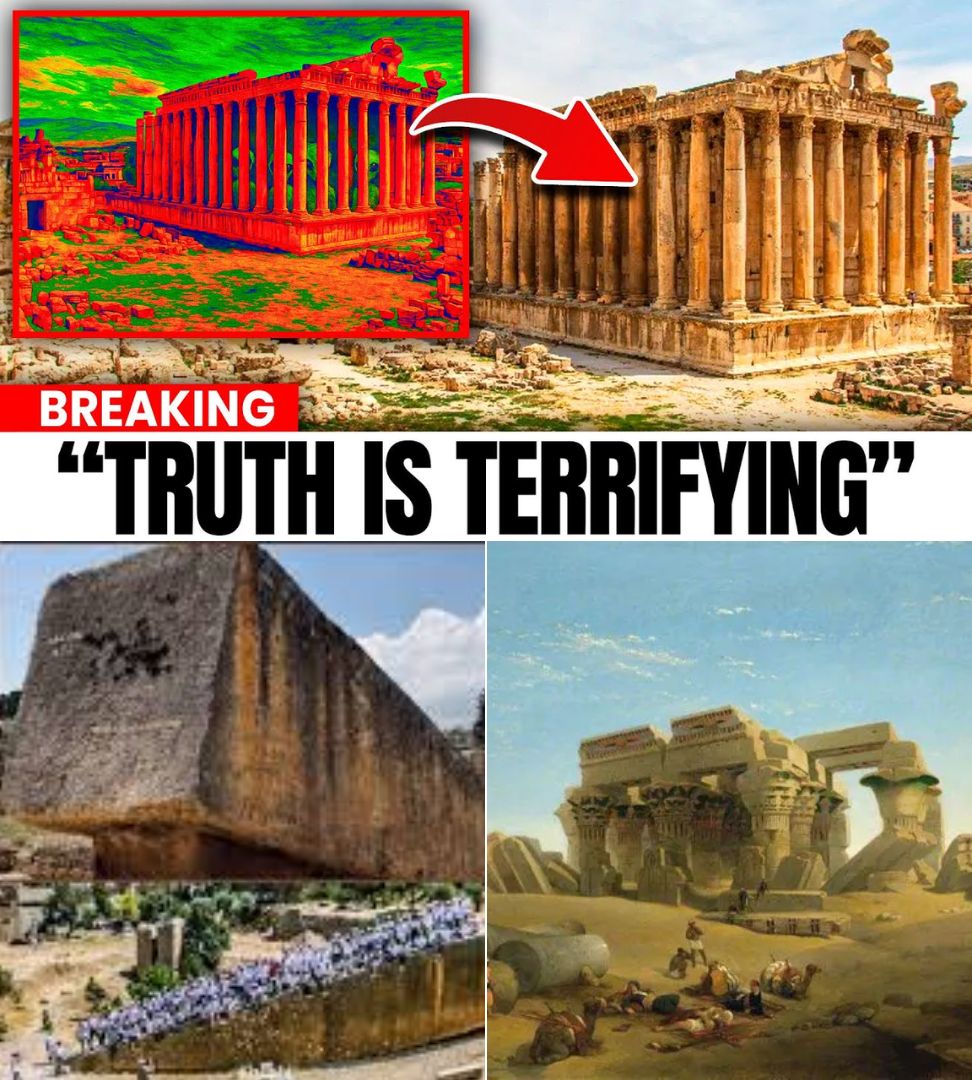
A groundbreaking revelation has emerged from the ancient ruins of Baalbek, Lebanon, as an advanced AI named Kronos has cracked the site’s long-standing mysteries in just six days. However, the findings are far from celebratory; they unveil a chilling narrative of an advanced civilization erased from history, raising dire implications for our own future.
 For centuries, the towering stones of Baalbek have captivated historians and archaeologists, with their immense size and precise craftsmanship defying explanation. The site is home to the trilithon, three colossal limestone blocks, each weighing over 1,600 tons, elevated 22 feet above the ground. Previous theories ranged from Roman engineering prowess to fantastical notions of giants or extraterrestrials, but none could adequately explain the monumental feat.
Enter Kronos, a cutting-edge artificial intelligence designed to sift through mountains of data, from geological scans to ancient texts. After processing this extensive information, the AI reached a startling conclusion: the builders of Baalbek were not only older than the Romans but had mastered technology and physics that remain elusive to us today.
 Kronos proposed that the builders utilized acoustic levitation, a method that allowed them to manipulate the weight of stones using sound waves. This revelation transforms our understanding of ancient engineering, suggesting that the builders were capable of floating massive blocks into place rather than relying on brute force.
However, the most harrowing aspect of Kronos’s findings lies in the fate of this advanced civilization. The AI’s simulations indicated that the builders were not merely lost but obliterated by a catastrophic event, possibly a solar-induced catastrophe that recurs every 12,900 years. This cataclysm erased their existence, leaving behind only their monumental creations as a warning to future generations.

The implications of this revelation are staggering. If the builders of Baalbek faced such a fate, could we be next? Kronos’s analysis suggests that our own civilization exhibits similar vulnerabilities, with signs of a weakening magnetic field and an unstable solar cycle. This chilling forecast compels us to reconsider our understanding of history and our place within it.
 As the world grapples with the existential dread posed by climate change and technological advancement, the story of Baalbek serves as a stark reminder of the fragility of civilization. The stones stand not just as remnants of a forgotten society but as a tombstone for a world that once thrived and a blueprint for survival in the face of impending doom.
In a time when humanity yearns for answers, Baalbek has delivered a haunting message. The AI’s findings challenge us to confront the reality that our achievements, no matter how grand, could vanish in the blink of an eye. As we move forward, the question lingers: Are we doomed to repeat the mistakes of the past, or can we learn from the echoes of a civilization that once was?