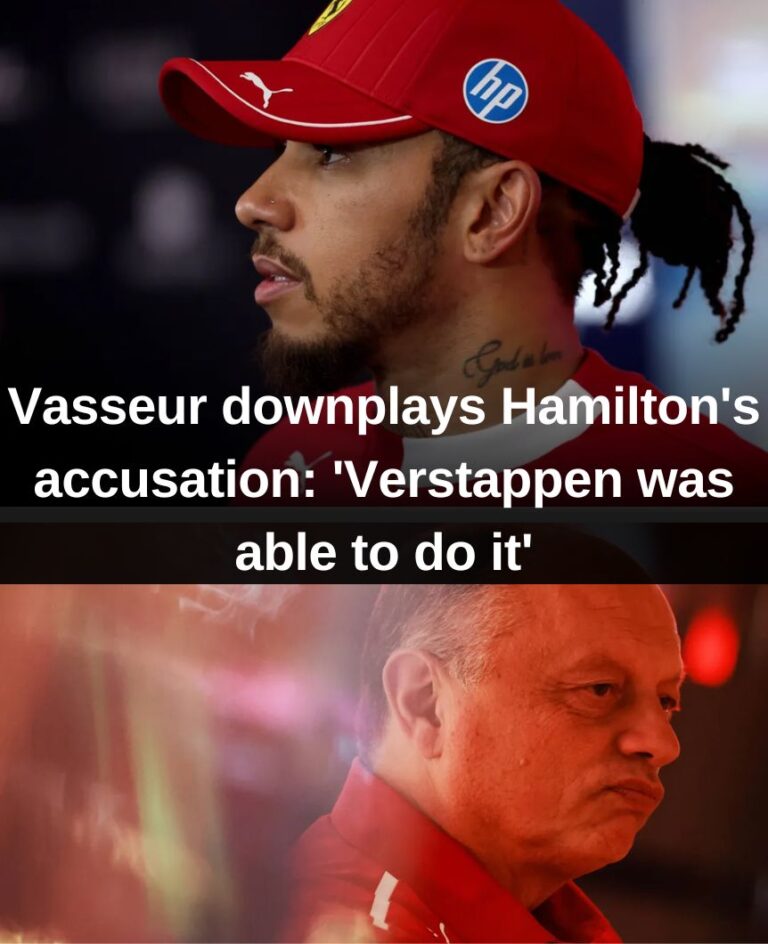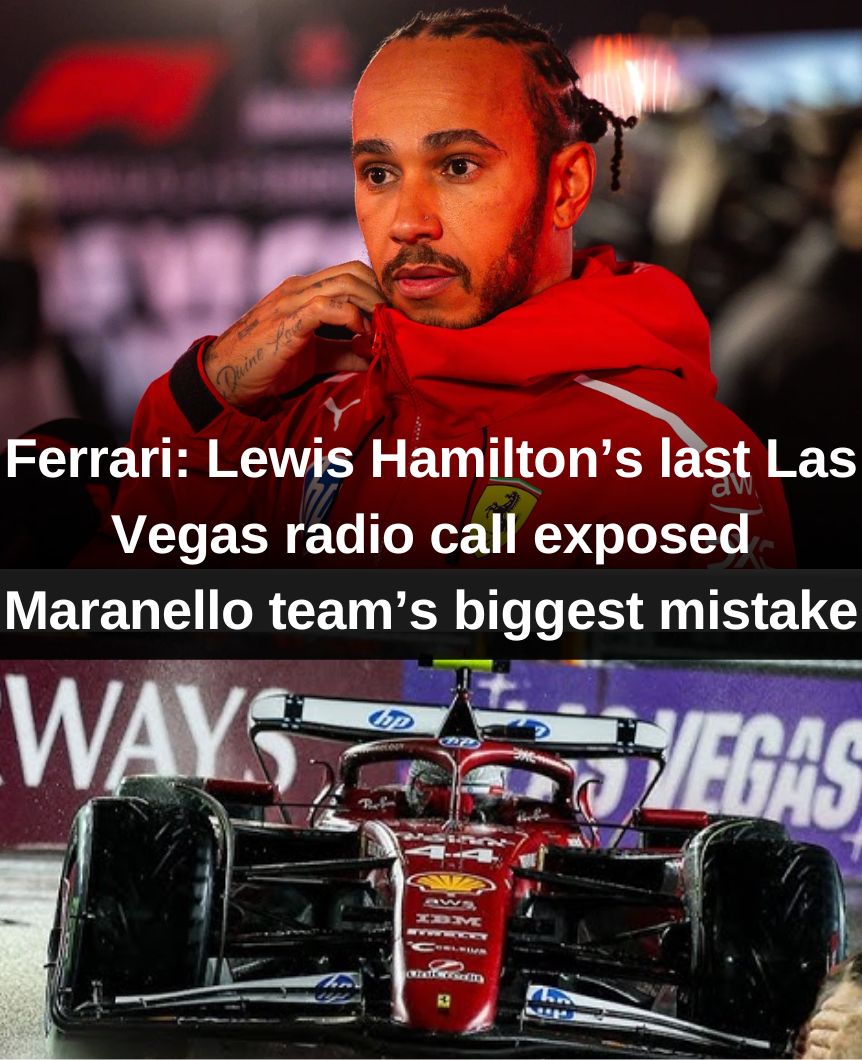
The Las Vegas Grand Prix turned into another bruising weekend for Ferrari driver Lewis Hamilton, whose frustrations were made clear through several revealing radio messages during the race. Despite his determination to climb through the field, the seven-time world champion found himself battling the same recurring limitations that have defined Ferrari’s 2025 Formula 1 campaign.

Lewis Hamilton arrived in Las Vegas hoping for redemption after a string of difficult qualifying sessions, but the weekend quickly unravelled. By qualifying last on pure pace — becoming the first Ferrari driver since Giancarlo Fisichella in 2009 to start from the very back without carrying any grid penalties — he set the tone for what would be another uphill struggle under the neon lights of the Strip Circuit. It was an especially bitter blow considering that in the 2024 edition of the race, he had surged from tenth on the grid to an impressive second place.
Lewis Hamilton avoids early chaos but cannot unlock Ferrari’s pace
The race start at least opened a glimmer of opportunity. From the final row, Lewis Hamilton expertly stayed clear of the heavy drama that unfolded ahead of him. Liam Lawson’s clash with Oscar Piastri and Gabriel Bortoleto’s collision with Lance Stroll — which also sent Pierre Gasly spinning — allowed Hamilton to immediately gain several places. Within minutes he had climbed seven positions, but once the early chaos settled, progress slowed dramatically.
Much of Lewis Hamilton’s race was missing from the world feed, but the team radio painted a far clearer picture of the challenges he faced. His remarks repeatedly highlighted the weaknesses of the Ferrari SF-25, particularly in terms of braking confidence, tyre consistency, and straight-line efficiency — issues that have affected both Lewis Hamilton and Charles Leclerc at various points throughout the season.
Brake issues, tyre struggles and traffic stall Hamilton’s charge
During the opening laps, Lewis Hamilton informed race engineer Riccardo Adami that the brakes were giving him trouble again. Ferrari fans have become used to drivers reporting inconsistent brake bite from the SF-25, but Hamilton emphasised that the problem was significantly affecting his pace. He also noted that overtaking was unusually difficult, referencing the long periods spent trapped behind Esteban Ocon’s Haas during the first stint.
When asked for tyre feedback, Lewis Hamilton reported that the hard compound “did not feel great,” adding that the rear stability was poor. The situation deteriorated further when Alex Albon made contact with him mid-race, leading to a five-second penalty for the Williams driver — an ironic echo of the penalty recently given to the Briton for his clash with Franco Colapinto in Brazil.
Ferrari’s pit strategy leaves more questions than answers
With the entire field planning a one-stop race, the key decision for Ferrari centred on when to make the switch to the medium tyres. Lewis Hamilton was instructed to react opposite to Nico Hülkenberg’s Sauber — a common strategic approach intended to gain track position — but the plan did not unfold as intended. Hamilton eventually pitted on lap 30, only to endure a 3.1-second stop, noticeably slower than Ferrari’s usual standards in 2025.
The British driver expressed concern immediately afterward, suggesting that the stop came too early and questioning how long he would be forced to run on the medium compound. Riccardo Adami attempted to reassure him by explaining that the medium degradation was lower than anticipated, but Lewis Hamilton’s frustration was clear.
With ten laps remaining, the seven-time Formula 1 world champion sent a blunt message over the radio, saying he no longer had any performance left in the car. By the time he crossed the finish line in tenth place, he again questioned how the strategy had left him behind rivals he previously held an advantage over, particularly noting the surprising recovery of both Mercedes drivers.
Adami responded by pointing out that Kimi Antonelli’s early switch to hard tyres on lap 3 — followed by a remarkable 48-lap stint — had transformed the Italian driver’s race. Ferrari conceded that the hard compound had proven to be the superior tyre in Las Vegas, complicating their strategic decisions.
One of Lewis Hamilton’s strongest fightbacks of 2025, but not enough for Ferrari
Despite the disappointment, Lewis Hamilton still showcased his trademark racecraft. Gaining nine places from his grid position marked his second-largest comeback of the season. Only his drive at the Belgian Grand Prix — where he surged from eighteenth to seventh — featured more overtakes.
Yet this small positive does little to mask the deeper issues. Lewis Hamilton joined Ferrari expecting to challenge for wins and podiums consistently, especially after the encouraging end to Ferrari’s 2024 season. Instead, he has spent the majority of 2025 recovering from poor qualifying sessions, many of which have left him too far back to fight for meaningful results. He has openly admitted to feeling disappointed with his Saturday performances, even describing himself as “absolutely useless” after qualifying in Hungary.
Charles Leclerc has also held the upper hand in qualifying, outpacing Lewis Hamilton over one lap at 17 of the 22 races so far. And although the Briton’s race pace remains strong — as shown by his overtaking numbers — the lack of a competitive baseline on Saturday continues to hinder Ferrari’s ambitions.
Ferrari faces a crucial turning point ahead of 2026
With Formula 1’s next major rule reset arriving in 2026, Ferrari must dramatically improve the underlying weaknesses of the SF-25’s philosophy to give Lewis Hamilton and Charles Leclerc a competitive platform. The team’s inability to maximise qualifying, manage tyre windows consistently, and maintain confidence on the brakes has cost them dearly throughout 2025.
For Lewis Hamilton, Las Vegas served as another reminder of how far Ferrari still needs to go. His frustration on the radio spoke volumes — not only about this race, but about an entire season defined by missed opportunities, strategic misjudgements and an inconsistent car. If these issues carry into 2026, the questions surrounding his long-term F1 future will only grow louder.