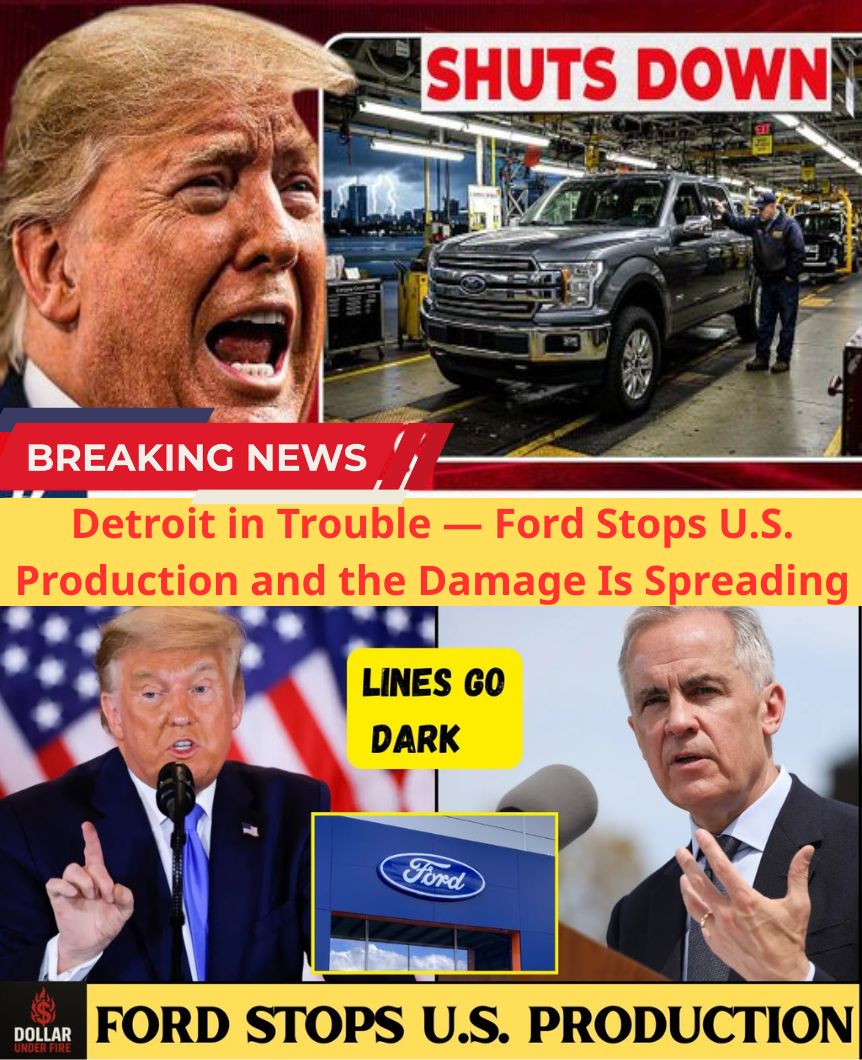
Ford Motor Company, a stalwart of American manufacturing, has abruptly halted production at several U.S. facilities, sending shockwaves through the automotive industry and the economy at large. This unexpected decision, attributed to escalating tariffs on imported auto parts, has exposed the fragility of the U.S. industrial system. With costs surging and supply chains disrupted, Ford’s production freeze is not merely a corporate adjustment; it’s a harbinger of broader economic turmoil that threatens jobs and local economies across the Midwest and beyond.
In May 2025, Ford’s shutdown affected key production sites, including the Chicago assembly plant, known for flagship models like the Explorer and Lincoln Aviator. Officially termed a routine rescheduling, industry insiders recognized it as a forced pause, signaling deeper issues within Ford’s supply chain. The imposition of a 25% tariff on imported auto parts has created a perfect storm, raising costs and complicating production schedules that once ran seamlessly.
The ripple effects of this tariff-induced crisis have been severe. Analysts estimate that nearly $4,900 in additional costs per U.S.-built vehicle has emerged, leading to significant financial losses for Ford. In just one quarter, the company reported a staggering $1.5 billion hit, forcing it to raise vehicle prices by up to $2,000. This price adjustment, while labeled a mid-year correction, was largely driven by the increased costs of essential components, which have become both scarce and exorbitantly priced.

The impact extends beyond Ford, as competitors like Nissan, Toyota, and Honda have also begun to feel the strain. Production slowdowns and price hikes are becoming industry-wide phenomena, leading to a surge in new vehicle prices and diminishing inventories. In April alone, new vehicle prices rose by 2.5%, one of the sharpest increases seen in recent years.
The real consequences of Ford’s production halt are being felt in communities tied to these manufacturing plants. As assembly lines quieted, layoffs and reduced shifts became commonplace, causing local economies to falter. Diners, auto shops, and small retailers are all experiencing the fallout, echoing the instability felt by workers who had previously enjoyed job security.

As Ford grapples with these challenges, the situation has drawn attention from union leaders and labor advocates, who are increasingly vocal about worker morale and job security. The trade war, initially perceived as a protective measure, has instead revealed the vulnerabilities within America’s manufacturing landscape, raising questions about the long-term viability of U.S. auto production.

The geopolitical ramifications are also significant. China has retaliated with tariffs on U.S.-made vehicles, effectively shutting down one of Ford’s critical international markets. This has compounded the challenges faced by the automaker, as it now struggles with both domestic production issues and lost export opportunities.
Ford’s leadership is now faced with the daunting task of recalibrating its operations amid a rapidly changing landscape. While the company has made substantial investments in U.S. manufacturing, the unpredictability of tariffs and supply chain disruptions complicates long-term planning. Executives have acknowledged that the current environment is fraught with uncertainty, making it increasingly difficult to maintain stability.
As the automotive industry navigates this turbulent period, the stakes remain high. The fallout from Ford’s production halt serves as a stark reminder of the interconnectedness of global supply chains and the far-reaching consequences of domestic policy decisions. The future of American manufacturing hangs in the balance, raising critical questions about resilience, adaptability, and the ability to compete in an increasingly complex global economy.